


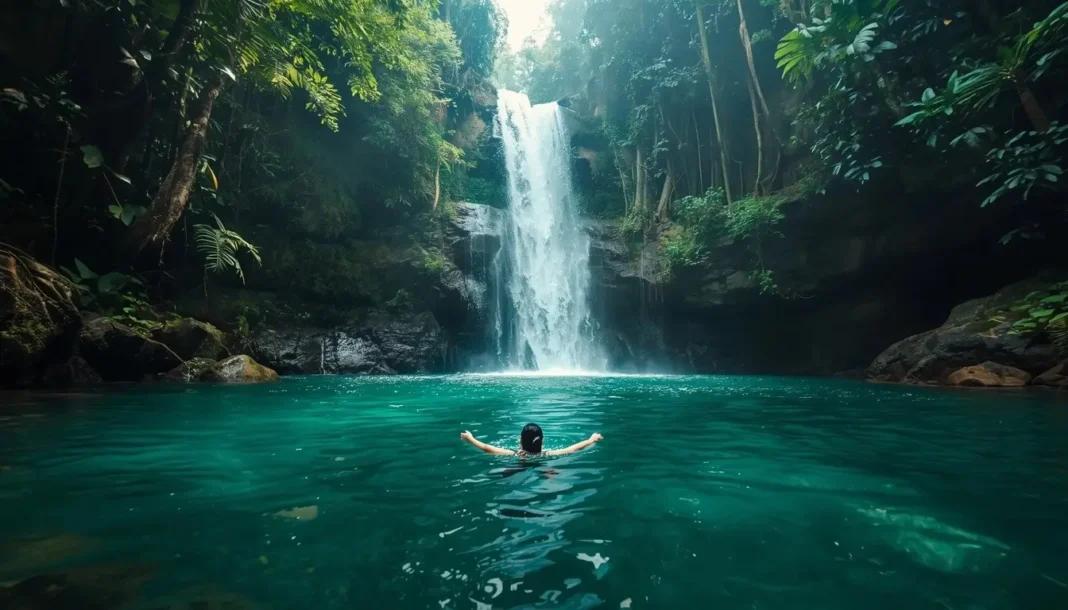
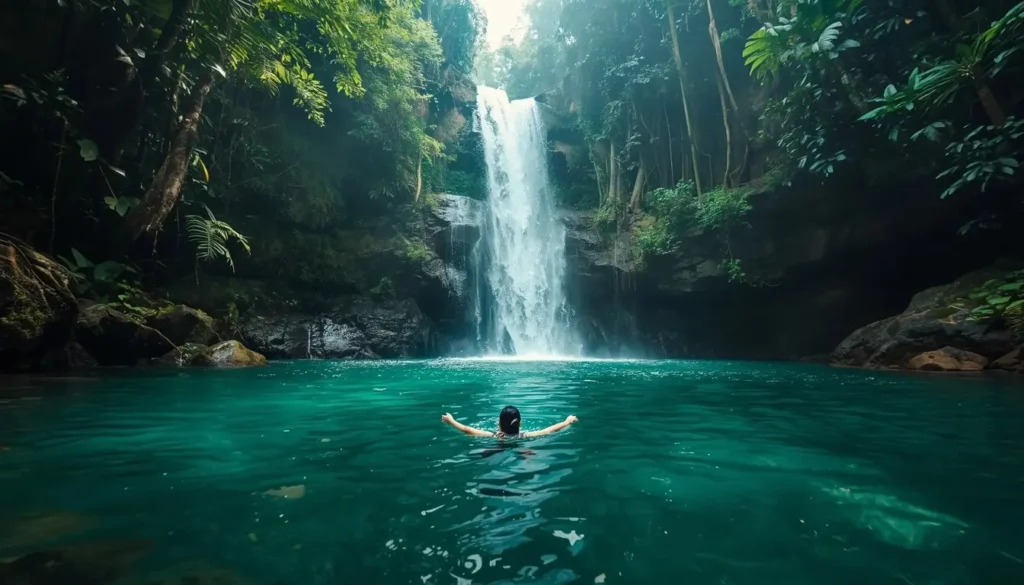
The best Ubud waterfall for swimming in 2026 is Taman Sari Waterfall, which offers a wide emerald natural pool, easy access, and clean water suitable for most visitors. Close behind are Suwat Waterfall — known for its deep turquoise plunge pool reaching up to 7 meters — and Tibumana Waterfall, which sits inside a lush jungle canyon with a calm, waist-deep pool ideal for relaxed swimming.
The Ubud area, located in the cultural heartland of Bali’s Gianyar and Bangli regencies, is home to dozens of waterfalls fed by volcanic highland rivers that drop into natural gorges year-round. Of the many options available, seven stand out as the most rewarding for visitors seeking to swim, not just photograph.
Quick Summary: Best Ubud Waterfalls for Swimming (2026)
| Waterfall | Best For | Entrance Fee | Swimming Quality | Difficulty |
|---|---|---|---|---|
| Taman Sari | Best overall swim | IDR 25,000 | Excellent | Easy |
| Suwat | Deep pool & adventure | IDR 40,000 | Excellent | Easy |
| Tibumana | Peaceful jungle swim | IDR 25,000 | Good | Easy |
| Tegenungan | Iconic spot + facilities | IDR 20,000–25,000 | Good (watch currents) | Easy |
| Ulu Petanu | Hidden gem, calm pool | IDR 20,000–25,000 | Good | Easy–Moderate |
| Kanto Lampo | Wading & photography | IDR 20,000–25,000 | Shallow wading only | Easy |
| Tukad Cepung | Cave & light beam experience | IDR 30,000 | Ankle-deep wading | Moderate |
Best months to visit: April – October (dry season) Best time of day: 7:00 AM – 10:00 AM Essential items: Cash (IDR), non-slip footwear, swimwear, quick-dry towel
1. Taman Sari Waterfall — Best Ubud Waterfall for Swimming Overall
Why Visit
Taman Sari Waterfall sits approximately 14 km from central Ubud, accessible in around 30–40 minutes by car or scooter. The falls begin as a single curtain before dividing into multiple cascades that tumble over moss-covered terraced rock into two distinct natural pools. The lower pool is wide, clear, and reflects an emerald green color on sunny mornings. A gentle cascade along the side wall creates a natural pressure-massage effect — a feature that sets Taman Sari apart from most other swimming waterfalls in this region.
Swimming Conditions
The lower pool accommodates most adult swimmers. Water depth varies — shallower near the edges, deeper toward the center. Clarity is excellent during the dry season. The pool is spacious enough that visitors rarely feel crowded, even on busier days.
Entrance Fee
IDR 25,000 per person (approximately USD 1.50). Parking is free. Changing rooms available on-site.
Opening Hours
8:00 AM – 5:30 PM daily. Pool area may operate on shorter hours (9:00 AM – 3:00 PM) on certain days — confirm at the entrance gate on arrival.
Difficulty Level
Easy. The path from the car park takes 5–10 minutes on maintained gravel and stone stairs. Suitable for most fitness levels, including older visitors and families with children above age 5.
Best Time to Visit
Early morning on a dry-season weekday, ideally before 10:00 AM. Sunlight hits the water directly during morning hours, making the pool appear especially vivid. Midday and weekends attract higher visitor numbers.
Safety Tips
- Do not dive — pool depth at the edges is inconsistent.
- Avoid swimming directly beneath the main cascade, where falling water creates a strong downcurrent.
- Rock debris can fall from the cliff face above the falls.
- Non-slip footwear is recommended for the descent path.
Location: Ngenjung Sari Village, Bakbakan, Gianyar Regency
2. Suwat Waterfall — Best for a Deep Natural Pool
Why Visit
Suwat Waterfall offers one of the deepest natural plunge pools in the Ubud waterfall circuit. The 15-meter cascade drops into a turquoise pool that reaches 5–7 meters at the center — a rarity among accessible waterfalls in central Bali. Beyond swimming, the site includes a cave behind the waterfall and a bamboo raft available for hire, allowing visitors to paddle out for close-up photographs.
The site is managed by the local Suwat village community. Entrance fees contribute directly to local development. The atmosphere remains quieter than more commercialized sites, making it especially suitable for visitors seeking a less-crowded experience close to Ubud.
Swimming Conditions
Excellent for confident swimmers. Shallow edges provide a gradual entry point suitable for less experienced swimmers, while the pool center offers a genuine deep-water swimming experience. The clear turquoise water and surrounding jungle create conditions that feel refreshing and natural.
Entrance Fee
IDR 40,000 per person for international visitors (IDR 20,000 for Indonesian nationals). Bamboo raft hire costs an additional IDR 25,000. Cash only — no ATM nearby.
Opening Hours
8:00 AM – 6:00 PM daily.
Difficulty Level
Easy. Approximately a 5–10 minute walk from the car park, descending around 60 steps on a maintained paved path. Changing rooms and basic toilet facilities are available near the entrance.
Best Time to Visit
Early morning during the dry season (April–October). The pool is at its calmest and clearest before 10:00 AM. Weekend afternoons see more visitors.
Safety Tips
- The pool center reaches 5–7 meters in depth — suitable only for confident swimmers.
- Inspect landing areas carefully before attempting any cliff jumps; avoid rocky edges.
- Avoid swimming when water appears murky after heavy rainfall — current strengthens considerably.
- Mobile signal is weak near the waterfall; download offline maps before visiting.
Location: Suwat Village, Gianyar Regency — approximately 12 km from Ubud (20–30 min drive)
3. Tibumana Waterfall — Best for a Peaceful Jungle Swim
Why Visit
Tibumana is a twin-channel waterfall where two separate streams fall roughly 20 meters into a shared pool framed by a deep green jungle canyon. The approach is part of the appeal: visitors walk through small rice fields, cross bamboo bridges over a freshwater stream, and descend through dense tropical vegetation before the waterfall comes into view.
The site maintains a more intimate feel than comparably accessible waterfalls, and the combination of clean water, manageable pool depth, and on-site attendant supervision makes it one of the most reliably safe swimming spots near Ubud for mixed-ability groups. You can also stop by a club in Ubud after swimming here.
Swimming Conditions
The pool sits waist- to chest-deep across most of its area, making it comfortable for a broad range of swimmers. Water is generally fresh and clean. The twin-channel design creates two distinct zones — visitors can position themselves in the calmer sections away from the main current.
Entrance Fee
IDR 25,000 per person. Parking costs IDR 5,000 for scooters and IDR 10,000 for cars. Changing rooms and locker hire available.
Opening Hours
7:00 AM – 6:00 PM daily.
Difficulty Level
Easy. Approximately 140 stairs with handrails from the car park to the waterfall. Families with young children visit regularly. The well-maintained path includes bamboo bridges and shaded sections throughout.
Best Time to Visit
7:00 AM – 9:00 AM on weekdays. Light enters the canyon walls at this hour, illuminating the falls from above. Dry season (April–October) delivers cleaner water; wet season brings more water volume but reduces visibility.
Safety Tips
- A local attendant monitors the pool area using a flag warning system to signal unsafe zones — follow these instructions.
- Avoid the zone directly beneath the twin falls where downcurrents are at their strongest.
- Non-slip footwear is essential for the descent, particularly after rain.
- Children should be supervised closely near the water’s edge at all times.
Location: Banjar Bangunlemah Kawan, Apuan Village, Bangli Regency — approximately 15 km from Ubud (30–45 min drive)
4. Tegenungan Waterfall — Best for Facilities and First-Time Visitors
Why Visit
Tegenungan is the most visited waterfall in the Ubud area, and it holds that position for legitimate reasons. A 15-meter cascade drops with impressive volume into the Petanu River, surrounded by the best visitor infrastructure of any waterfall on this circuit: restaurants, cafes, a glass bridge viewpoint, day clubs, changing rooms, and well-maintained stairs. For first-time visitors or those who want a full day out combining natural scenery with surrounding amenities, it is the most complete option. If you are in Ubud, you can stop by the cafes in the area.
Swimming Conditions
Swimming is permitted in designated pool areas. The water is powerful near the base and can carry strong currents, particularly after rainfall. During the dry season the water runs clearer; the wet season can turn it brown from upstream sediment. Visitors must remain within marked safe zones.
Entrance Fee
IDR 20,000–25,000 per person (varies by entry point). The glass bridge viewpoint carries an additional fee of approximately IDR 50,000.
Opening Hours
Approximately 7:00 AM – 6:00 PM daily. Day clubs and restaurants operate their own hours.
Difficulty Level
Easy, though the 168 stairs to the base can be demanding on the return journey. Not recommended for visitors with significant mobility limitations.
Best Time to Visit
Before 9:00 AM or after 4:30 PM to avoid the peak tour group window (10:00 AM – 3:00 PM). Tegenungan is one of the most-visited day-trip destinations in Bali and crowds at midday are significant.
Safety Tips
- Currents near the base are a genuine hazard, particularly for weaker swimmers and children.
- No permanent lifeguard is stationed at the pool — adult supervision of children is essential at all times.
- If water appears brown after recent rainfall, skip swimming on that visit.
- Water volume and current increase substantially after heavy rain.
Location: Tegenungan Village, Kemenuh, Gianyar — approximately 10 km south of Ubud (20–30 min drive)
5. Ulu Petanu Waterfall — Best Hidden Gem with a Swimmable Pool
Why Visit
Ulu Petanu Waterfall does not appear on most mainstream Ubud waterfall lists, which keeps it quiet and genuinely off the beaten path. The site carries significant historical and cultural weight — it served as a meditation site for the Balinese king Maya Denawa in the 10th and 11th centuries, and local communities continue to conduct purification ceremonies here. In addition to the main waterfall, the site includes a second smaller falls and a cave, offering a layered experience that more commercialized destinations cannot match.
Swimming Conditions
The natural pool is clear and swimmable, fed by mountain water flowing through tropical jungle. The calm atmosphere and low visitor numbers make the experience noticeably more peaceful than at better-known spots. Water quality is generally good during the dry season.
Entrance Fee
IDR 20,000–25,000 per person (cash only). Changing facilities and toilets available near the entrance.
Opening Hours
6:30 AM – 5:00 PM daily.
Difficulty Level
Easy to moderate. Approximately 90 stairs from the entrance to the waterfall base. Stairs are steep in sections but well-maintained with handrails.
Best Time to Visit
Early morning or late afternoon. This is consistently one of the least crowded waterfalls in the Ubud area, often quiet even during high season. Morning light through the jungle canopy is particularly atmospheric.
Safety Tips
- Respect any ongoing Balinese Hindu ceremonies — step back and wait quietly if a ceremony is in progress.
- Do not enter the cave without proper footwear; the interior is unlit.
- Mobile signal may be absent near the waterfall — download offline maps before departure.
Location: Kedisan area, Gianyar Regency — approximately 13 km from Ubud (20–30 min drive)
6. Kanto Lampo Waterfall — Best for Wading and Photography
Why Visit
Kanto Lampo is widely recognized for its striking visual composition: water cascades in multiple tiers down a wall of dark volcanic rock, and visitors can climb the rocks to position themselves within the falls. The name translates from Balinese as “light” and “shine,” referencing the way sunlight interacts with the water. The site also holds a spiritual dimension — offerings and small shrines are present throughout, and local ceremonies take place regularly.
Swimming Conditions
Kanto Lampo functions primarily as a wading waterfall rather than a swimming destination. The pool at the base is shallow — typically ankle to knee-deep, occasionally reaching chest height in certain sections. It is excellent for cooling off and wading after the visit, but visitors seeking a proper swim should pair this stop with Tibumana or Taman Sari on the same day.
Entrance Fee
IDR 20,000–25,000 per person. Locker hire available for IDR 10,000. Parking is free. Showers, toilets, and changing rooms provided on-site.
Opening Hours
6:00 AM – 6:00 PM daily.
Difficulty Level
Easy. A 5–10 minute walk down stone stairs from the car park. Suitable for most ages and fitness levels.
Best Time to Visit
6:30 AM – 8:00 AM. Early morning light filters through the jungle canopy and produces a natural light-beam effect on the water surface. Photography queues build significantly from 10:00 AM onward during peak season.
Safety Tips
- The rocks at the base and on the climbing face are extremely slippery — water shoes with strong grip are essential.
- Avoid climbing the central rock face without carefully assessing footing at each step.
- Water volume increases rapidly during and after heavy rainfall; avoid the water under these conditions.
- The staircase descent can also become slippery after rain — maintain a firm grip on handrails.
Location: Beng Village, Gianyar Regency — approximately 11 km from Ubud (20–30 min drive)
7. Tukad Cepung Waterfall — Best for a Unique Cave Experience
Why Visit
Tukad Cepung is the most visually distinctive waterfall on this list. The approach involves walking through a narrow river canyon and then wading through ankle-deep water into a cave, where a single waterfall drops through a crack in the ceiling. When sunlight enters through the cave opening at the right angle, it produces a striking light-beam effect that draws visitors from across Bali. The experience of standing inside a cave beneath a waterfall with natural rays of light overhead is genuinely unlike anything else in the Ubud area.
Swimming Conditions
Wading and shallow dipping only. The water inside the cave and along the canyon approach is ankle- to shin-deep. This is not a swimming waterfall in the traditional sense, but the immersive walk-through-water experience and cave atmosphere make it a compelling addition to any waterfall itinerary.
Entrance Fee
IDR 30,000 per person (cash only).
Opening Hours
Opens from approximately 7:00 AM. The light beam effect is best observed between 9:00 AM and 11:00 AM on clear days.
Difficulty Level
Moderate. The 15–20 minute walk includes steep stone stairs and wading through a shallow rocky riverbed. Not recommended for young children or visitors with balance or mobility difficulties.
Best Time to Visit
9:00 AM – 11:00 AM on a clear dry-season morning. The light effect is absent on overcast days and is significantly reduced during the wet season.
Safety Tips
- The riverbed inside the canyon contains sharp rocks — water shoes are essential, not optional.
- Do not enter the canyon when river levels are elevated after heavy rain; flash flooding can occur quickly in the narrow gorge.
- Hold the handrail on all staircase sections — steps are steep and uneven.
- Check current water level conditions with local transport drivers before visiting.
Location: Tembuku, Bangli Regency — approximately 1 hour from central Ubud
Waterfall Comparison Table
| Waterfall | Distance from Ubud | Entrance Fee (2026) | Pool Depth | Crowd Level | Family-Friendly |
|---|---|---|---|---|---|
| Taman Sari | 14 km / 30–40 min | IDR 25,000 | Moderate–shallow | Low–Medium | Yes |
| Suwat | 12 km / 20–30 min | IDR 40,000 | Deep (5–7 m) | Low–Medium | Edges only |
| Tibumana | 15 km / 30–45 min | IDR 25,000 | Waist–chest deep | Medium | Yes |
| Tegenungan | 10 km / 20–30 min | IDR 20,000–25,000 | Varies (strong current) | High | With close supervision |
| Ulu Petanu | 13 km / 20–30 min | IDR 20,000–25,000 | Moderate | Low | Yes |
| Kanto Lampo | 11 km / 20–30 min | IDR 20,000–25,000 | Ankle–knee | Medium–High | Yes, easy terrain |
| Tukad Cepung | ~30 km / 60 min | IDR 30,000 | Ankle wading | Medium | Older children only |
Which Waterfall Is Best for Families?
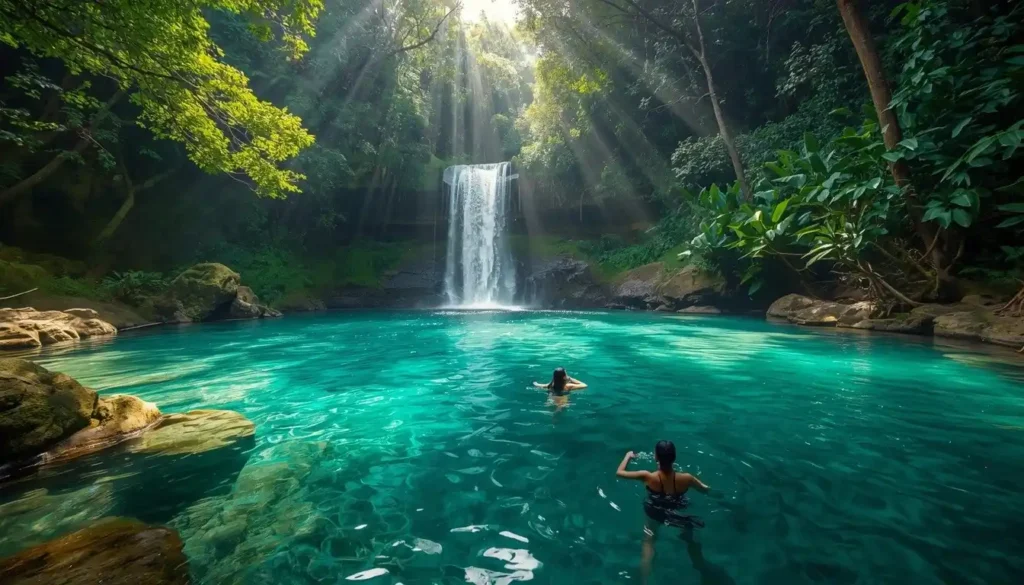
Tibumana Waterfall is the top recommendation for families traveling with young children. The maintained path features handrails throughout, the natural pool holds a safe waist depth, and an on-site attendant monitors the swimming area. The approach through rice fields and across bamboo bridges is genuinely engaging for children of all ages.
Taman Sari Waterfall is the second-best family option. The path is short and easy, the terraced pool design allows children to wade in shallower sections while adults swim further in, and the surrounding jungle setting is memorable without requiring significant physical effort.
Kanto Lampo Waterfall suits families who prioritize accessible terrain over a deep swim. The pool is completely safe for young children at ankle to knee depth, and the dramatic terraced rock formations make for striking family photographs.
For families with older children (ages 10 and above) who are confident swimmers, Suwat Waterfall offers the most adventure — the bamboo raft, the cave behind the falls, and the deeper pool add layers of experience beyond a standard waterfall visit.
Tegenungan Waterfall requires very close adult supervision of children at all times due to its strong base current. Tukad Cepung is not recommended for young children due to its steep staircase approach and rocky canyon wading.
Swimming Safety Tips at Ubud Waterfalls
Natural waterfall pools in the Ubud area carry genuine risks that differ from those of managed swimming pools. The following precautions apply at every site on this list:
1. Never swim directly beneath the main cascade. The downward force of falling water creates dangerous undertows. Falling debris — rocks and branches — is also common along the cliff face above natural pools.
2. Wear non-slip footwear at all times. Algae-covered rocks are present at every waterfall on this circuit. Standard flip-flops provide no meaningful grip on wet stone. Water shoes or sandals with back straps and textured soles are the minimum appropriate footwear.
3. Check water color before entering. Clear or blue-green water indicates clean, safe conditions. Brown or discolored water signals high sediment levels from upstream rainfall and often accompanies a stronger current. Do not enter the water when it appears brown.
4. Avoid waterfalls immediately after heavy rain. River levels can rise quickly in gorge environments. Water volume, current strength, and debris all increase significantly within hours of substantial rainfall upstream.
5. Carry IDR cash only. Every waterfall on this list operates on a cash-only basis for entrance fees, locker hire, and food stalls. The nearest ATMs are in Ubud town center. Carry IDR 50,000–100,000 per person to cover all costs comfortably.
Frequently Asked Questions
What is the best Ubud waterfall for swimming? Taman Sari Waterfall is widely regarded as the best Ubud waterfall for swimming, offering a large emerald natural pool, an easy 5–10 minute access path, and clean water during the dry season. For visitors seeking a deeper pool, Suwat Waterfall is the preferred choice, with a central depth of 5–7 meters. Families with young children are best served by Tibumana Waterfall, which combines a safe pool depth with well-maintained terrain.
Can you swim at Tegenungan Waterfall? Yes, swimming is permitted at Tegenungan Waterfall within designated safe zones. The current near the base of the falls can be strong, particularly after rain or during the wet season (November–March). Water quality and clarity are generally better between April and October. Visitors must stay within marked areas and supervise children closely.
When is the best time to visit waterfalls near Ubud? The dry season from April to October offers the best conditions for swimming near Ubud, with clearer water, lower river levels, and safer currents. Within that period, arriving between 7:00 AM and 10:00 AM provides the best lighting, the smallest crowds, and the most comfortable temperatures.
Are waterfalls near Ubud safe for swimming? Most waterfalls near Ubud are safe for swimming when visited during the dry season with appropriate precautions. Primary hazards include slippery rocks, strong currents near the base of falls, and falling debris. Wearing non-slip footwear, avoiding the zone directly beneath the main cascade, and refraining from swimming after heavy rainfall significantly reduces risk at all sites.
Is Tibumana Waterfall good for swimming? Tibumana Waterfall is one of the better options for swimming near Ubud. The natural pool maintains a waist- to chest-deep level across most of its area, and an on-site attendant monitors the pool using a flag warning system. The setting is peaceful and the water generally clean. Swimming directly under the main cascade is not advised.
Key Takeaways
- Taman Sari Waterfall is the best Ubud waterfall for swimming in 2026 — accessible, emerald-pooled, and genuinely swimmable for most visitors.
- Suwat Waterfall leads for confident swimmers seeking a deep pool (5–7 m) with extras including a cave and bamboo raft experience.
- Tibumana Waterfall is the most family-friendly option — waist-deep pool, easy terrain, handrails throughout, and on-site attendant supervision.
- Tegenungan Waterfall delivers the best facilities and most dramatic volume, but requires caution near the base current, especially for children.
- Kanto Lampo and Tukad Cepung are best categorized as wading and photography experiences rather than swimming destinations.
- All entrance fees are cash only. Carry small-denomination IDR. No ATMs are available near any waterfall on this list.
- Dry season (April–October) is the definitive best period for water clarity and swimming safety across all sites.
- Early morning (7:00–10:00 AM) is universally recommended — smaller crowds, better natural light, and cooler temperatures.
- For a full-day swimming circuit combining the three best pools, the recommended route is Taman Sari → Tibumana → Suwat, all within 30–45 minutes of each other.